

Coming Out of Comfort
(Boston Pride 2018)
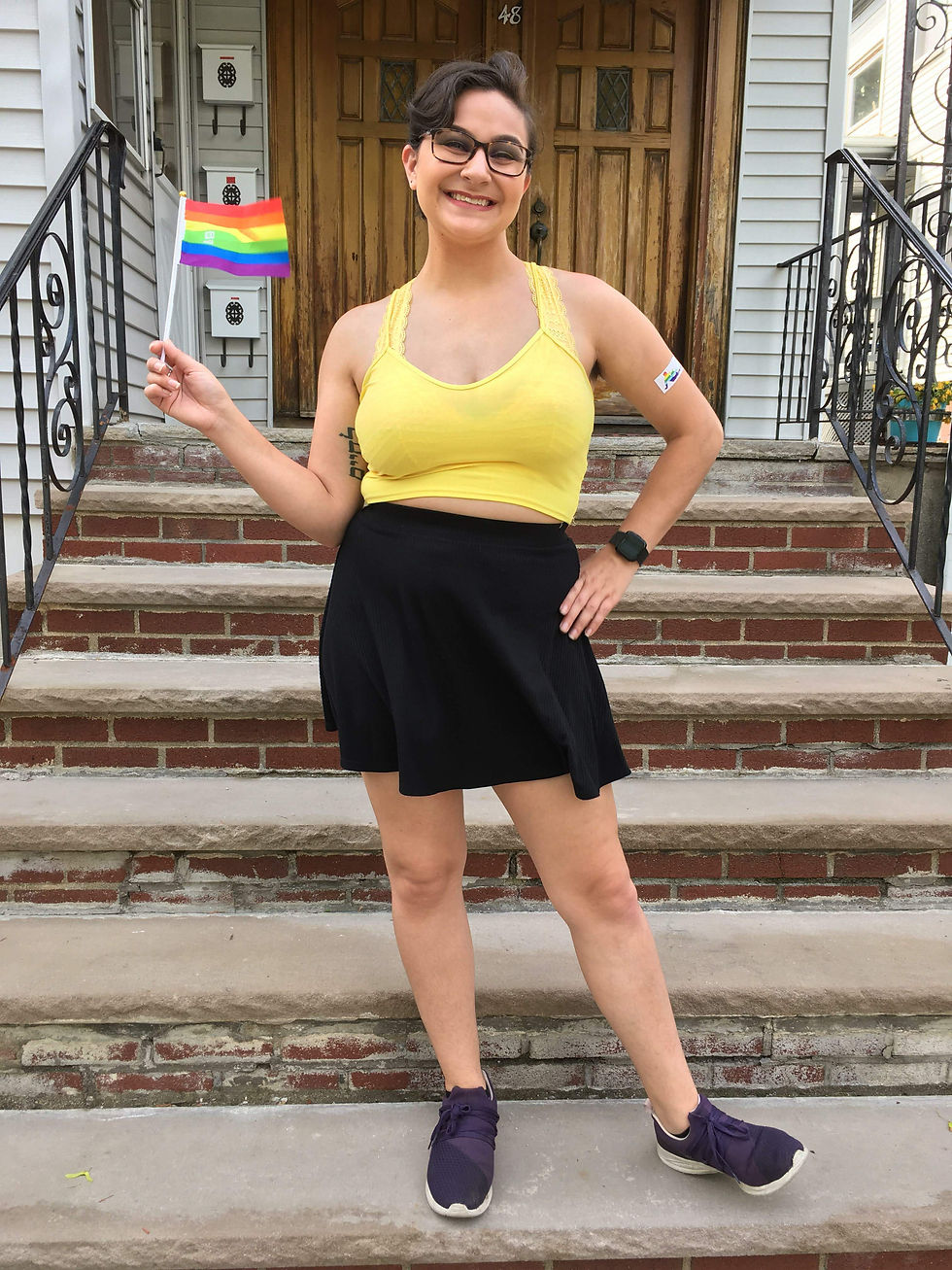
Similar to many other queer and trans folks, my coming out was a long, drawn out process. From a technical standpoint, one could argue it’s still in progress. I was twenty years old when I told friends that I wanted to start using “they/them” pronouns. One night, our close knit gaggle of athletes sat together for hours and discussed queer concepts, pronouns, my own personal definition of “non-binary.” There was a sense of everyone belonging in this conversation, that questions could be asked freely and answers would be listened to. I felt a beautiful acceptance from the group, a warm reassurance that I was safe to be my most authentic self in the company of these people.
I began the practice that many are familiar with: coming out constantly in classrooms, coffee shops, and dining halls. Coming out to every coworker, professor, and people with whom I’m flirting in bars who just can’t seem to hear me over the music. There are plenty of stumbles. “But isn’t ‘they’ plural?” “What do you mean by, ‘pronouns’?” “You’re a girl though (pause for a quick look up and down)... right?” Questions that all appear innocent but fail to assume that I may be tired of providing answers. For efficiency--saving both time and energy--I have a programmed response for each of these queries. My cerebrum has descended into a mess of sticky notes and definitions, resources and annotations, all bookended by, “But just know, another trans or non-binary person’s experience could be very different from my own.”
Telling my older sister was the next logical step. She was the first in the family to know I was bisexual, and she received that news with comforting ease. After I tell her, she asks me some questions about how I’d like to be referred. She’s respectful and supports me, adopting gender neutral language quickly into her vocabulary. It’s encouraging, a step in the right direction. It’s nice to go to her apartment and be called by the right name, the right words. We don’t always understand each other; we have a conversation that doesn’t quite hit the right notes about Trump’s transgender military ban. At a cold bus stop one night outside the gym, I tell her she doesn’t need to share every piece of transphobic media with me that she sees. I know it’s there. These days, we’re on the same page. It’s nice knowing that I can count on her for backup.
I came out to friends in early 2017. It is not until June of 2019, Pride month, that I fold my hands on the green kitchen counter of my childhood home and tell my mother that I’m not her daughter. That I’m simply her child and I’m not a girl. There are lots of tears, though my declaration is taken well. We touch briefly on pronouns, but don’t go further in depth (I regret this now). My father is even able to make a joke, something about how it’s not much of a surprise, and I laugh because he’s right.
It is currently the end of June, 2020, the last day of Pride month. There were no parades this year, no underground glitter raves or back-bending death drops or cute cocktails with names like “bi-tai.” There were marches, protests, vigils all through the cities and towns of the United States. Even all over the world. We stayed inside for the virus, but came back out, masks on, when George Floyd was murdered by police over a counterfeit twenty dollar bill. The protests go on for days, and a black trans man is killed by police. Tony McDade. The world loses two beautiful black trans women within twenty-four hours. Riah Milton and Dominique Fells. We march through the streets of Roxbury, Boston, Brookline, Dorchester. We say their names under our PPE and lose our voices with the repetition of, “Black trans lives matter!” Pride is not for the white cis gays this year. It never was in the first place.
It has been three and a half years since those first friends listened to me explain my gender, an explanation no trans person owes. It’s normal for the occasional slip up among them, the wrong pronoun used here and there, and always corrected right after. There are the few constant offenders, those who rarely refer to me in the manner I’ve asked. These people know who they are. They would read this and try to apologize later, a mess of “I’m still learning!” and “It’s just so hard.” A close friend muted me on Twitter after I brought attention to a celebrity aligning themselves with a known transphobe. I don’t think she realizes that I know she muted me. Another old friend feels it’s necessary to pose a question about the consideration of biological sex vs. gender on my Instagram post about gender neutral language and vocabulary.
Earlier this month, I said, “Fuck it,” and came out to my less than 500 Instagram followers, including several members of extended family. The reception has been adequate and respectful. It’s been a year since I came out to my parents, and also informed them of my partner’s own use of “they/them” pronouns (with their permission, of course). My mom gets flustered when I correct her use of “she/her” pronouns, but to her credit, she once caught herself and then, frustrated, said, “Geez, you’re not a girl.” My dad makes a big show on our phone calls by asking, “How is they doing?” He doesn’t understand why this isn’t helpful. In his defense, I also have not explained why it isn’t helpful.
Straight, cisgender people expect me to explain myself all the time. The heteronormative culture demands constant access to queer people, as though our having different experiences means we always want to be talking about it. On the contrary, I do not want to talk about it. There are times when I still have some patience in me, and choose to provide education or clarification. In these moments, I gauge what is to be gained or lost by having or not having the conversation. But I assure you, no LGBTQ+ individual--or black person or indigenous person or person of color--wants to take time out of their day to debate the validity of their existence.
This is not to say we should never have open discussions about diversity or sexuality or gender or race. The world needs more of these conversations, and the people who truly need to learn will never participate. When we ignore the issues, we avoid creating solutions. As a queer, trans person, my greatest wish is to exist without question, to not have my trans colleagues always leading the educational workshops that may make their own jobs safer. The onus remains on us to teach the cis how to navigate interactions with us.
I am proud of every marginalized person who has ever stood up and told their story. I am proud of every marginalized person who stays quiet, because to tell would be exhausting. Personally, I will continue to be vocal and amplify the voices of others. I am in this fight, but I was drafted. A person’s gender is not a choice, and to be myself means to face an intolerant enemy. The question is not whether we should have these conversations; we should. The question is why do straight, cis, white people demand answers of queer, trans, black, indigenous people, and people of color when there is a world of resources available to answer their questions? An internet full of articles and documentaries and books that oppressed people already took the time to prepare?
Those asking do not want to do the work. The work is uncomfortable, and these people live in a world curated to their own comfort. No one asks straight people how they know they’re straight unless it is an immediate response to the question, “How did you know you were gay?” Every day is an opportunity to unlearn the harmful biases programmed deep within us by our culture and media. Every day we do not actively focus on unlearning homophobia, transphobia, racism, and all forms of hate, is another day that we fail the people the system was built to crush.
If all the cis people I knew took ten minutes out of their day to do the hard work, to settle into the discomfort, perhaps I would not be so exhausted by their questions. If all the cis people I knew stopped asking me questions and turned to Google instead, maybe they would harness the necessary skills to complete an interaction with a trans person without being obtuse. It’s not that the people asking questions are looking to the wrong people for guidance, although some are. We usually know the answers, we are just tired of repeating them. If I never had to explain “they/them” pronouns to another person, it would be too soon.
Comments